
Empowering Student Learning: Hutto Elementary's Multimodal Media Center
As part of its mission to bring more instructional technology into the classroom, Decatur County Schools in Georgia has been exploring multimodal literacy experiences for elementary students. The effort is part of a statewide push to find new ways to deliver literacy instruction across all types of media, including right in the school’s media center.
In this post, we'll take a look at:
“Our ELA standards are changing next year, and one of the things that’s really different about them is how kids will be interacting with information across many modes,” says Amy Zock, director of instructional technology and digital learning. “With this in mind, we’ve been redesigning how we use our media centers to make them more of a hub, and how to include more STEM activities in those hubs.”
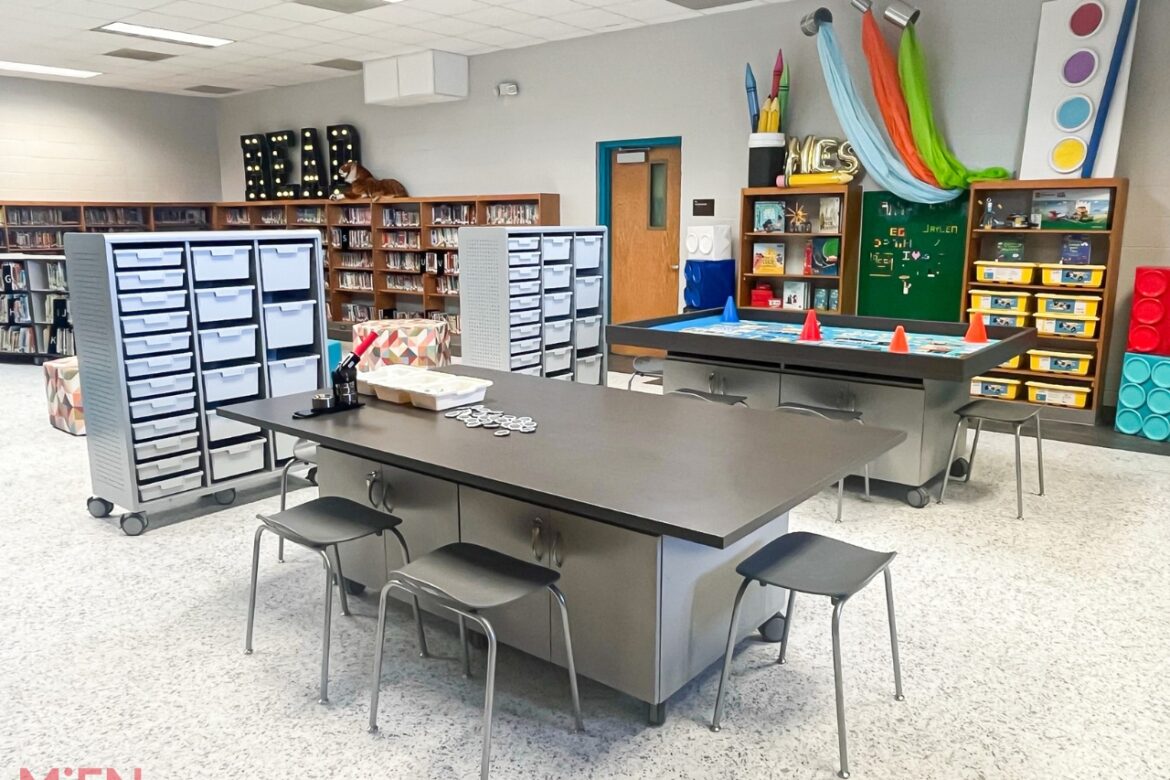
For Hutto Elementary School’s new media center, the district incorporated many different modern learning tools in an environment where students can learn, collaborate and/or work independently. The school partnered with MiEN, PowerUpEDU and Woz ED to create a space that truly exemplifies the district’s overarching goal of supporting students on their multimodal literacy journeys.


Infusing Accountability into Learning
Right out of the gate, Hutto Elementary School began looking at ways to create spaces where resources could be shared, and where students could take ownership of the actual learning. Makerspaces fit the bill perfectly because they help infuse accountability into the hands-on learning experience.
And with that, the school began looking for the right machines and curriculum for its new media center. It worked with the three outside providers to create a common space where everything “flowed properly,” says Zock, and where students were encouraged to collaborate and work together despite the largely one-on-one nature of digital tools.
For example, Zock says the school put some thought into how traditional wall posters or bulletin boards—both of which have always been used to showcase exemplary work—could be transferred into the digital environment. PowerUpEDU provided guidance for the school’s new active floor and AR/VR equipment.
“We were very deliberate in creating ways to display the digital work of students in all of our designs, and really thought about how to systematically achieve that,” says Zock, who was careful not to complicate the management aspect of those displays. “It takes a bit more work to put something up digitally than it does to just staple it to the wall. If you’re designing, you really have to think about that.”
Making the Space Sing
Within the new space, Zock knew that she wanted specific “zones” for certain activities, but that the walls between those zones could be blurred based on the type of learning happening in those areas. Working with MiEN, the school came up with a very modular, adaptable furniture, fixture and storage approach that would fit the bill perfectly.
Installing moveable storage fixtures, for example, would support quick room reconfigurations and avoid “big clunky storage cabinets that are pinned to the wall,” says Zock. “We didn’t want moving the cabinets into another room to be a big hassle.”
The school also had a very specific budget and wanted the outcome to look “as cool as possible,” says Zock, who appreciates MiEN’s willingness to come and work within that budget. “The question was, how could we put lipstick on the rest of this pig to make the biggest impact? I trusted MiEN to help answer that question by selecting the perfect wall color, for example. That was really helpful, and it made the space sing.”


Focusing on Flexibility
Hutto Elementary School’s new media center includes a lot of digital signage that teachers and staff can control in various different ways. For example, there are display cases where the students’ finished products can be showcased. The space also features a wide variety of flexible, wheeled furniture options that can be repositioned quickly.
“Unless it’s a bookcase along the wall, nothing is tethered because we never know when we’ll have to clear everything out so we can fly drones for the day and then bring everything back in place,” Zock explains. “We needed everything to be simple, easy and lightweight, and MiEN was essential in that thought process.”
The space itself is a giant, square room (which was previously a cafeteria) with two classrooms off the back and a lot of glass. One side is a makerspace zone that’s separated from the fiction section of the library with mobile carts. On the other side is a whiteboard, soft seating and rolling bookshelves for fiction books.
“We still have fiction around the exterior, but it’s now in a much smaller footprint than when we had stationary shelving and ugly carpet in that area,” says Zock. The library’s nonfiction section includes an active floor area and a mobile classroom with foldable desks. For seating, the school worked with MiEN to select wobbly stools, regular chairs and soft seating, all of which are easy to use and change around to meet the current need.
“That modularity really paid off about two weeks ago when we had 120 students rotating in four groups throughout the media center,” says Zock. “We cleared the entire space out, moved everything around the edges and set it up as a giant corn maze where students were coding robots.”
For students who want to read aloud or to themselves, the school also included a small space filled with counter-height tables and soft seating. “It’s very quaint,” says Zock. “We incorporated a giant, open book overhead into the design, so the space has a canopy. It’s been a huge hit with the students who come there to enjoy a book.”
Reimagining More Spaces
Decatur County Schools has spent the last few years creating makerspaces where students can go to “produce” things across various different modes. And while literacy remains a core focus for the district—and the state of Georgia as a whole—this district also worked with MiEN and PowerUpEDU to leverage the power of makerspaces at an existing high school and a new middle school that’s currently in the design phase.
“We have a makerspace in every school now, and we’re always looking at how to best flow kids through those spaces and how to make that work with the other initiatives,” says Zock. “That’s where MiEN and PowerUpEDU have really been helping us reimagine our spaces and transform them into very modern, adaptable learning environments.”