
The Evolution of a Learning Space: A Montessori School's Renovation Journey
Since opening its doors in 2000, Creative Montessori Academy has been providing students with an outstanding education based on the work and observations of Maria Montessori, an Italian physician, educator and innovator who developed her educational approach through scientific observation of children.
In this post, we'll take a look at:
Located in Southgate, Mich., Creative Montessori Academy has grown from 125 students to more than 660, which necessitated a new physical setup for the very popular school, which became a public academy in 2023. The school was authorized by Central Michigan University to provide a K-8 Montessori-based program starting for the 2024-25 school year.
At that point, the school’s leadership and staff—which includes many seasoned Montessori teachers—knew that a physical revamp of its current campus was in order. That meant adding new middle school classrooms, breakout spaces, comfortable seating and a maker’s space room for project-based collaborative learning.
Other additions included a new administrative office and conference room, and a new tech lab, band/music room and science lab. The latter includes new creative tools for instructional levels and an outdoor space for hands-on activities. With this significant and necessary update, the school can accommodate its growing campus community and ensure that students and teachers have the learning environment they deserve.
Guiding them Toward the Best Product Options
The full school renovation was designed by an architecture firm that the school partnered with. The school turned to MiEN for help outfitting its new spaces with modern, comfortable and collaborative furniture, fixtures and color schemes. “When they came to visit our showroom, they liked almost everything that they saw,” says Claire McNaught, senior interior designer at MiEN.
“Many of those products wound up in the school’s final design plans,” says McNaught, who enjoys showing school administrators and leaders the “up close and personal” look at some of MiEN’s most popular product options. “Being here and interacting with the products and seeing them firsthand is a very elevated experience, especially from the designer’s and architect’s point of view.”
The interior designer for the project had already completed the layout, for example, but was using “placeholder products” until the final decision was made about furniture and fixtures. “I helped out with that, just in terms of guiding what they had in the design and the intent behind it,” says McNaught, “and then guiding them towards a product that would meet their needs.”
Putting the Right Pieces in Place
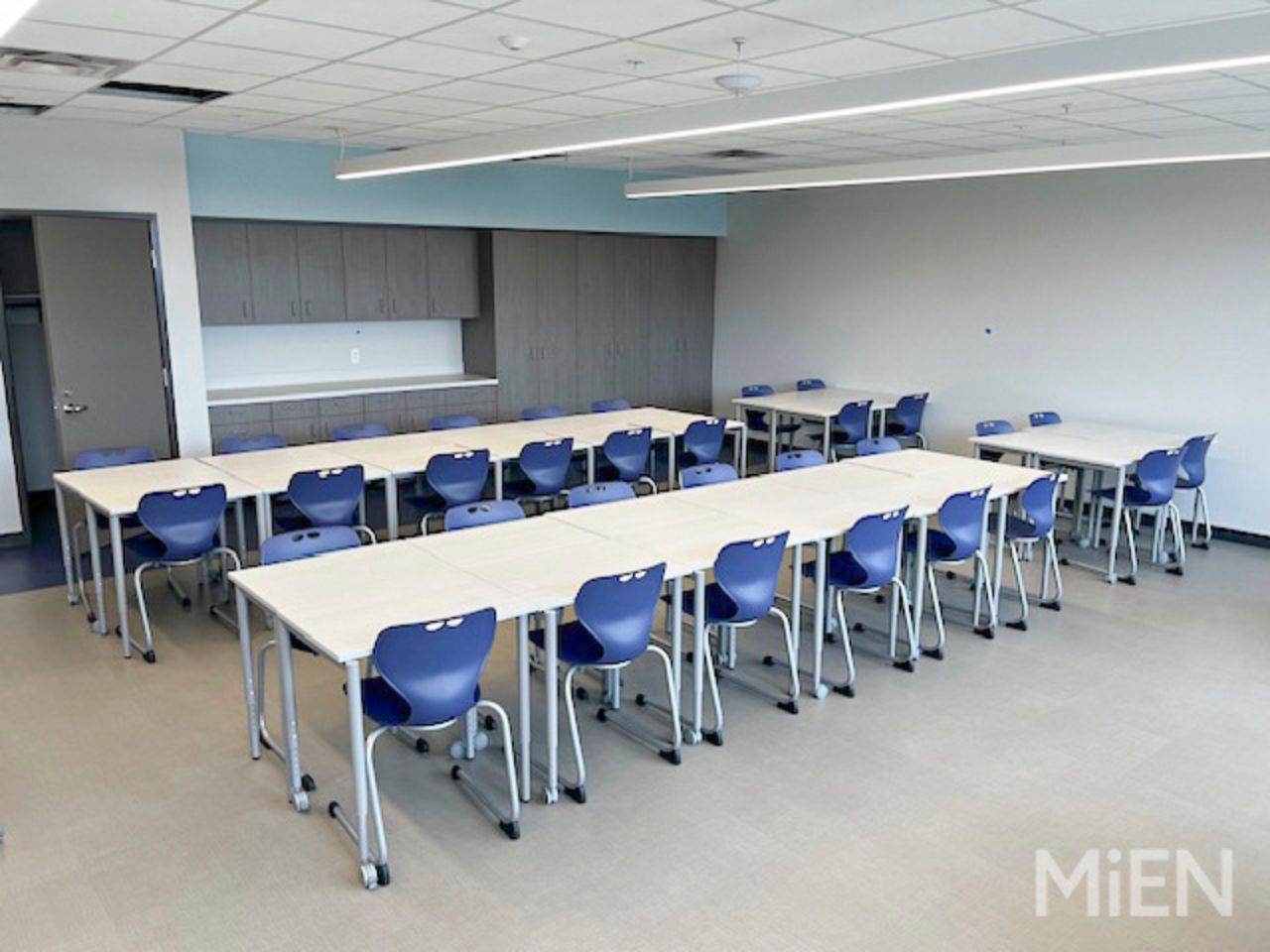
Some of the key pieces that the school decided on are SST adjustable stacking tables, which are flexible, height-adjustable and great for changing the volume of the space. The classrooms are also equipped with Chameleon square chairs and Chameleon round inside seating and Gem desks, which offer a multitude of configuration options.
The school really likes the varying heights of tables (in the commons area) and their new, soft seating options. For its multi-use CTE space, which is equipped with STEM lab tables, it decided on the KIO Tinker that can seat four students and includes hidden storage space.
“You can take the shelves out and put them inside, transforming it into a standing high table,” McNaught explains. The school is also using a 3-seat curved KIO table as a broadcasting station. These and other innovative options truly support the Montessori methodology, which fosters independence in students. “That absolutely makes sense with the design,” she says.


Supporting Collaborative and Independent Learning
Creative Montessori Academy’s learning spaces include a mix of collaborative zones and independent work areas. All of its furniture is modular and moveable, which means spaces can be quickly and easily reconfigured to accommodate the learning. For example, seating can be rotated and tables pulled apart for use by a single student, or the same pieces can be pushed together to form a large configuration that supports bigger groups.
The finishes selected by the school align with broader Montessori themes, which focus on natural elements. For example, laminates look like something you’d see in nature and the hues are muted and pastel-like. “Blue is just an inviting color to begin with, and it goes with the school colors,” says McNaught. “The color palette really tied the whole space together.”
Watching it All Come Together
McNaught really enjoyed working with the school’s interior designer, who played an important role in deciding which finish would look best in every room—all the while ensuring each individual space reflected the school’s broader vision and mission.
“Whenever we had a question about what finish to use or where to place something, we would just go back to that vision of the Montessori school,” says McNaught, who also helped the designer make decisions about ultimate space functionality (e.g., what’s the goal of the space? Is this for large group learning? Where will individual, quiet study take place? etc.).
MiEN also provided professional development for teachers who are now using the furniture and fixtures to teach their classes. Knowing that soft seating and adjustable-height tables are new for most, the company helps teachers work through any learning curves and extract the biggest value from their exciting new educational support tools.
“In most cases it really comes down to how the room is going to be used. Some teachers want to work in groups of four, others want their students to have all their materials accessible under their desks,” says McNaught, who usually recommends a variety of different open-ended seating solutions. “That really allows the architect and the designers to create a solution that addresses the school’s overarching goals and meets the needs of its teachers and students.”